

Fear of Failure: Why We Avoid Success and How to Overcome It
After meeting a lot of people, one thing I’ve definitely realised is that almost everyone has potential. Over the years, I’ve met people who are intelligent, hardworking, creative, and capable of achieving incredible things. They have the skills, the opportunities, and the determination to build the life they dream of.
Yet, many of them never even begin.
Not because they lack talent.
Not because they don’t have the resources.
But because they’re afraid of failing.
Before taking the first step, their minds are already filled with questions like:
What if I fail?
How will others see me?
Could I lose everything?
Am I simply not good enough?
These thoughts become so powerful that they give up before they’ve even given themselves a chance to succeed.
Maybe you’ve experienced this too.
Have you ever wanted to start something—a business, a YouTube channel, apply for your dream job, learn a new skill, or even tell someone how you feel—but stopped yourself before you even tried?
That’s what fear does.
When our minds become controlled by fear, we naturally start avoiding the very things that could improve our lives. We choose comfort over growth, certainty over possibility, and slowly begin missing opportunities that may never come again.
Over time, I realised something that completely changed the way I look at success.
It isn’t talent alone that makes people successful.
It isn’t even hard work by itself.
One of the biggest differences between people who achieve their goals and those who don’t is their ability to move forward despite the fear inside their minds.
Successful people feel fear too. The difference is that they don’t let it make their decisions for them.
I’ve learned this lesson the hard way.
There have been moments in my own life where I missed incredible opportunities simply because I was too afraid of failing. Looking back, I don’t regret the mistakes I made nearly as much as the chances I never took.
That’s exactly why I’m writing this article.
I want to show you how destructive the fear of failure can be, why it exists in the first place, and, most importantly, how you can stop letting it control your life.
What Is Fear of Failure?

I have one philosophy that I always follow.
Before trying to solve any problem, you first need to understand what the problem actually is. Most people don’t even know what they’re dealing with, so they end up wasting their time looking for solutions in the wrong places.
The human mind experiences a wide range of emotions, and one of the strongest among them is fear.
Fear is simply the emotion we experience when we believe something bad might happen. It has many forms. We can fear rejection, loneliness, change, uncertainty, or even the loss of the people we love.
But in this article, we’re going to focus on one specific type of fear: the fear of failure.
Fear of failure is the anxiety you feel before doing something important because your mind is already imagining everything that could go wrong.
Imagine you want to start a business, apply for your dream job, begin a new relationship, or chase a goal you’ve been thinking about for years. Before you’ve even taken the first step, your mind starts asking questions like:
- What if it doesn’t work?
- What if I fail?
- What if people laugh at me?
- What if I get rejected?
- What if I lose everything I’ve worked for?
Notice something.
None of these things has actually happened yet.
They’re the only possibilities your mind has created.
That’s what fear of failure does. It makes you suffer in your imagination before reality has even had a chance to unfold.
The truth is, every single person experiences this emotion at some point in their life. There isn’t a person on this planet who has never been afraid of failing. It’s a completely normal part of being human.
However, it’s important to understand that fear itself isn’t the enemy.
In healthy amounts, fear protects us. It stops us from making reckless decisions, reminds us to prepare, and encourages us to think carefully before taking risks.
The problem begins when fear becomes so strong that it stops us from taking any action at all.
That’s the difference between healthy caution and unhealthy fear.
Healthy caution says,
“Prepare well before you begin.”
Unhealthy fear says,
“Don’t even try because you might fail.”
One helps you grow.
The other keeps you exactly where you are.
Why Do We Fear Failure?

One thing that many people don’t realise is that the fear of failure isn’t something humans suddenly developed in modern times. Its roots go back thousands of years to when our ancestors lived as hunter-gatherers.
Back then, survival wasn’t guaranteed.
Every day they had to hunt for food, find shelter, and protect themselves from predators. A single mistake could have serious consequences. Taking unnecessary risks wasn’t just dangerous—it could mean losing their lives.
Because of this, the human brain evolved to become extremely sensitive to danger and failure. It learned to ask questions like: constantly
“What if this is dangerous?”
“What if something goes wrong?”
“Is it worth taking the risk?”
This way of thinking helped our ancestors survive for thousands of years.
The problem is that although the world has changed dramatically, our brains haven’t changed nearly as quickly.
Today, failing an exam, starting a business, applying for a job, or asking someone out isn’t life-threatening. Yet our brains often react as if these situations are just as dangerous as facing a wild animal.
Instead of protecting us from predators, our minds now try to protect us from embarrassment, rejection, criticism, and disappointment.
That’s why even before taking the first step, we begin imagining everything that could go wrong.
What if I fail?
Will people laugh at me?
Could I embarrass myself?
The fear feels real, even though our lives usually aren’t in danger.
This doesn’t mean our brains are broken. It simply means they’re still using an ancient survival system in a modern world.
The challenge isn’t to eliminate fear—because fear is a natural emotion. The real challenge is learning to recognise when that fear is protecting you and when it’s simply stopping you from growing.
After all, most of the opportunities we miss in life aren’t lost because we lack talent or ability.
They’re lost because we mistake discomfort for danger, and our minds convince us not to try in the first place.
Signs You Might Have a Fear of Failure

Now that you know what the fear of failure is and why it exists, you might be wondering:
“How do I know if I actually have a fear of failure?”
The truth is that most people don’t even realise they’re struggling with it. They simply think they’re lazy, unmotivated, or not capable enough. In reality, many of their behaviours are driven by an underlying fear of failing.
Here are some of the most common signs.
Procrastinating Important Tasks

One of the biggest signs of the fear of failure is procrastination.
People often believe they procrastinate because they’re lazy, but that’s not always true. In many cases, they’re simply trying to avoid the possibility of failing.
Think about it.
Never starting the project means you never have to face the possibility of it failing.
Avoiding the job application protects you from rejection.
Giving up on your dream keeps you from ever confronting failure.
Procrastination often feels like comfort in the moment, but over time it becomes one of the biggest obstacles to personal growth.
Starting Things but Never Finishing Them

This is something I’ve personally struggled with.
Many people begin a new goal feeling excited and motivated. But as soon as the work becomes difficult or results don’t come quickly, fear slowly starts taking over.
Thoughts like,
“What if this never works?”
“Maybe I’m not good enough.”
“What if all this effort is wasted?”
begin to fill their minds.
Instead of pushing through those doubts, they quit halfway. It isn’t always a lack of motivation that makes people give up. Sometimes it’s simply the fear of failing after investing time and effort.
Avoiding New Opportunities

Have you ever said no to an opportunity simply because you were afraid of what might happen?
Whether it’s applying for a better job, starting a business, speaking in public, or asking someone out, people with a fear of failure often avoid situations where success isn’t guaranteed.
The problem is that every opportunity comes with both risk and reward.
When fear controls your decisions, you don’t just avoid failure—you also miss the possibility of success.
Overthinking Every Decision

Overthinking is another common sign of the fear of failure.
Instead of taking action, you spend hours or even days thinking about every possible outcome.
Your mind keeps asking questions like:
What if I make the wrong decision?
Could everything go wrong?
Will people judge me?
The more you think, the more difficult taking action becomes.
Eventually, you become stuck in a cycle of thinking instead of doing.
Feeling Extremely Anxious Before Trying Something New

It’s completely normal to feel nervous before doing something unfamiliar.
However, if that anxiety becomes so overwhelming that it stops you from trying new things altogether, it could be a sign of the fear of failure.
Instead of seeing new experiences as opportunities to learn and grow, your mind only focuses on everything that could go wrong.
As a result, you remain in your comfort zone, even when you know deep down that you’re capable of much more.
If you recognised yourself in several of these signs, don’t worry. It doesn’t mean there’s something wrong with you. It simply means fear has been influencing your decisions more than you realised.
The good news is that fear of failure isn’t permanent. Once you understand how it works, you can gradually learn to manage it instead of letting it control your life.
Practical Ways to Overcome Fear of Failure
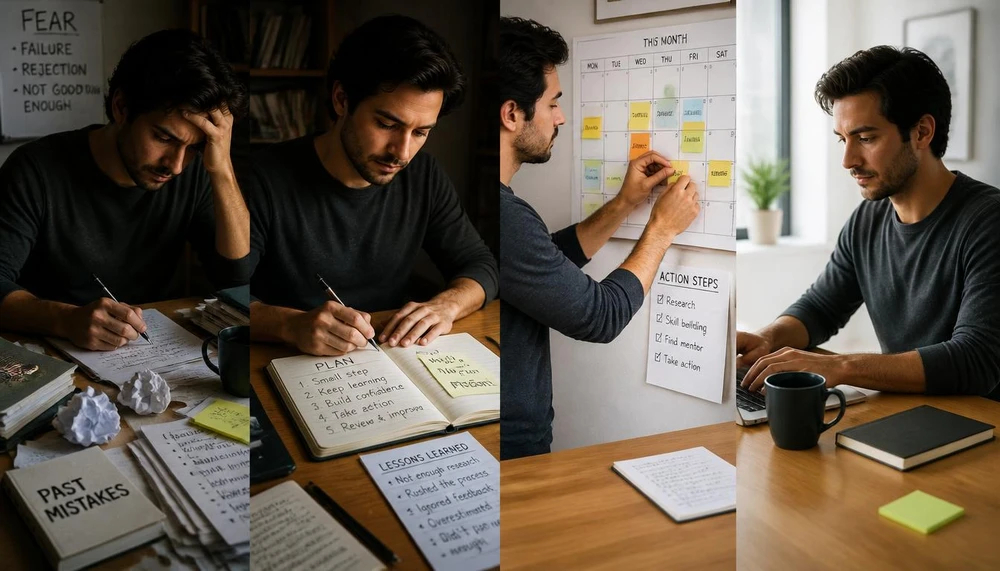
If you’ve realised that you’re struggling with the fear of failure, the first thing you need to do is accept it.
Don’t try to run away from it or pretend it doesn’t exist.
Many people believe that admitting they’re afraid somehow makes them weak. In reality, the opposite is true. Accepting your fear is one of the strongest things you can do because you can’t overcome a problem that you refuse to acknowledge.
The moment you accept that fear exists, you’ve already solved half the problem. The rest comes from gradually changing how you respond to that fear.
These are the techniques that personally helped me, and I hope they can help you too.
Accept That Failure Is Part of Success

One of the biggest reasons people never even begin is because they’re obsessed with success but terrified of failure.
They dream about achieving great things, yet they never leave any room for the possibility that things might go wrong.
The truth is that failure isn’t the opposite of success.
It’s part of the journey.
Almost every successful person you admire has failed more times than you probably know. The difference is that they didn’t see failure as the end. They saw it as feedback.
Every mistake teaches you something that success never could.
Failure shows you what doesn’t work, where you need to improve, and how to become stronger.
The sooner you stop seeing failure as something to fear and start seeing it as a teacher, the easier it becomes to keep moving forward.
Stop Chasing Perfection

One mistake I see people make all the time is waiting for the perfect plan.
Before they start anything, they want every answer, every solution, and every possible outcome figured out.
But life doesn’t work that way.
You’ll never have a perfect plan because many lessons can only be learned through action.
There’s a saying I really like:
“Think less. Do more.”
That doesn’t mean acting without thinking. It means not allowing endless planning to stop you from taking the first step.
Perfection doesn’t exist.
Some days, things will go exactly as planned.
Other days, they won’t.
The sooner you accept that, the more confident you’ll become in taking action despite uncertainty.
Focus on Learning Instead of Winning

One lesson that has stayed with me came from reading The Psychology of Money by Morgan Housel.
In the book, he explains that getting rich is one thing, but staying rich is something completely different.
I believe the same principle applies to every area of life.
Winning once isn’t what matters most.
Continuing to grow is.
The people who succeed over the long term are the ones who never stop learning.
Every experience, whether it’s a success or a failure, teaches you something valuable.
The day you stop learning is the day you stop growing.
Instead of asking,
“What if I fail?”
try asking,
“What can I learn from this experience?”
That simple shift in mindset changes everything.
Take Small Actions Every Day

One of the biggest mistakes people make is trying to change their entire life overnight.
They become motivated, make huge plans, and try to do everything in a single day.
A few days later, they feel exhausted and give up.
Real change doesn’t happen through giant leaps.
It happens through small, consistent actions repeated every day.
Instead of trying to transform your life overnight, focus on taking one small step today.
Read one chapter.
Exercise for twenty minutes.
Write one page.
Apply for one job.
Send one email.
Small actions may not seem impressive in the moment, but over time they create extraordinary results.
Remember,
Consistency beats intensity.
It isn’t what you do once that changes your life.
It’s what you continue doing even when motivation disappears.
Final Thoughts
Fear of failure is something that almost everyone experiences.
The difference is that some people allow fear to control their decisions, while others choose to act despite being afraid.
Reading articles like this can give you knowledge, but knowledge alone won’t change your life.
Action will.
Many people read motivational content, feel inspired for a day or two, and then return to the same habits that kept them stuck in the first place.
Don’t let that happen to you.
No one is coming to rescue you.
No one else can live your life, chase your dreams, or face your fears on your behalf.
That responsibility belongs to you.
So stop waiting for the perfect moment.
Take the first step, even if it’s a small one.
You may fail.
You may make mistakes.
But every step you take will teach you something that standing still never will.
Years from now, you probably won’t regret the times you failed.
You’ll regret the opportunities you never dared to pursue.
And that’s exactly why overcoming the fear of failure is one of the greatest gifts you can give yourself.